1.5 days (12 Hours)
Be at least 16 years old.
Upon successful completion of the course, candidates will be able to demonstrate proficiency in accordance with STCW Table A IV/2 and IMO
Model Course 1.25 by being able to:
• Explain the principles, structure, and operational requirements of the Global Maritime Distress and Safety System (GMDSS) in Sea Area A1.
• Operate VHF radiotelephone and Digital Selective Calling (DSC) equipment for routine, distress, urgency, and safety communications.
• Initiate, receive, acknowledge, and relay distress alerts and safety messages in compliance with IMO and ITU Radio regulations.
• Maintain an effective radio watch and use correct communication procedures to ensure safety of navigation and life at sea.
• Apply standardized GMDSS formats, call signs, and MMSI numbers when conducting marine radio communications.
• Perform basic testing, preventive maintenance, and fault identification on VHF-SRC equipment and its power supply.
• Comply with the legal and regulatory requirements of SOLAS Chapter IV and national licensing obligations for radio operators.
• Demonstrate practical competence in simulated emergency scenarios, including false alert cancellation and coordination with SAR services.
Candidates will be assessed through a theoretical written examination and a practical competency assessment at the end of the course.
A minimum passing grade of 70% must be achieved in each assessment.
Upon successful completion of the course and all required assessments, candidates will be awarded a Short-Range Certificate (SRC) for operating GMDSS radio equipment on vessels within Sea Area A1, in compliance with STCW Regulation IV/2 and Section A-IV/2 of the STCW Code, IMO Resolution A.703(17), and applicable ISSA requirements. The certificate is valid for five (5) years and may be renewed in accordance with ISSA requirements.
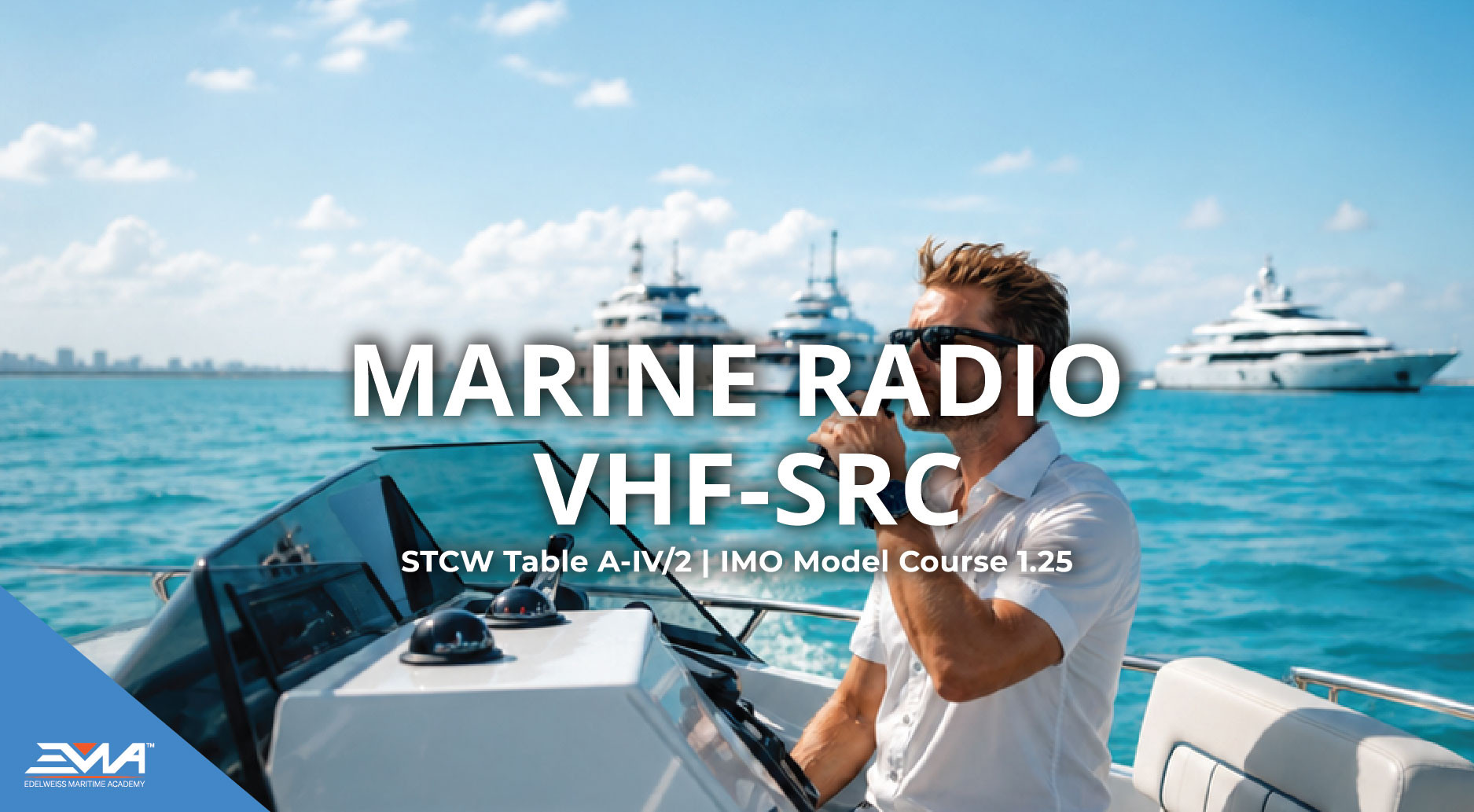
Marine Radio | VHF -SRC
No Review found